Wheat Growing in New Zealand:
Wheat was an unknown crop in New Zealand until Europeans introduced it to the country. Wheat was grown throughout New Zealand but by the 1870s was concentrated in South Canterbury, North Otago and eastern Southland. The earliest flour milling in New Zealand was done by hand, using a hand-operated mill such as the one missionary Samuel Marsden had with him in 1814. In 1834 the first mill was built at Te Waimate Mission Station’s farm.
The first Otago flour mill was built by the Somerville family in 1849 at Andersons Bay, Dunedin. In late 1866, when what became known as Clark’s Mill was built on the Kakanui River, there was only one earlier mill in the Oamaru area. By 1880 the district of Oamaru produced 28,000 tons of wheat; grain stores and flour mills flourished.
Wheat growing in New Zealand declined from about the beginning of the First World War, due to shortage of labour as well as the break-up of the large estates. A decade later, wheat was increasingly imported from Australia. The first half of the twentieth century saw the closure of many small mills.
The last mill to be built in North Otago in the nineteenth century is also the last mill still working today. It was established by Milligan and Bond at Ngapara, 25km west of Oamaru, in 1898. After 1905 only the Waianakarua mill, Ireland and Co’s, and J. and T. Meek’s Mills still in operated in North Otago along with those at Ngapara, and Clark’s Mill near Maheno.
Mill Technology:
Flour mills were defined by the way they were powered and how they ground grain. Nineteenth-century mills were generally powered by water, steam or wind. Traditionally, water-powered mills used mill wheels, whose power was determined by the flow of the water, and the size of the wheel. Wheels were described as ‘overshot’, ‘undershot’ or ‘breastshot’ depending on whether the water struck the wheel at the top, bottom, or near the centre. Greater power could be achieved by water turbines, and through the 1880s and 1890s traditional water wheels were phased out in their favour. In the mid-twentieth century electricity rendered turbines obsolete too.
The process of grinding the grain to separate the husk from the flour traditionally involved using pairs of millstones aligned on a central shaft. The top (‘runner’) stone rotated, while the bottom (‘bedstone’) remained still. Grooves in the stones left sharp edges that ground the grain, sending the flour outwards. The stones needed dressed or cleaned to ensure the edges ground the grain cleanly, or the flour would be discoloured.
From the 1880s roller technology began to replace grinding stones: the grain was picked over for chaff, and passed through steel break rollers. The bran was collected, and the grain went through sieves, purifiers and reduction rollers, after which wheat germ was collected. The flour was then refined through more rollers. Through the 1880s and 1890s mills were increasingly converted to roller technology.
Early Kakanui and Maheno:
The North Otago coast was a resource rich area for Maori and remains so today. Ngai Tahu’s prehistoric presence is shown through a range of archaeological sites from middens, urupa, to rock art. A midden on the north side of the Kakanui Township bears witness to the earlier presence of Ngai Tahu. Five Maori archaeological sites are recorded near the limestone cliffs to the east of Clark’s Mill, including rock paintings and petroglyphs, and there is further evidence of Maori occupation at nearby Totara.
In June 1848 the government purchased 20,000,000 acres of the South Island from Ngai Tahu chiefs, including land at Maheno. Reserves were to be designated for Maori in perpetuity, but this was only completed after the purchase by Walter Mantell, under Governor Grey’s instructions. In October Mantell met with Chief Rawiri Te Mamaru at Kakanui, where he marked off a reserve of 75 acres. At nearby Moeraki, which had long been an important settlement for Maori, there was ongoing dissatisfaction with the 500 reserve. In 1853 the government increased the Moeraki reserve by 75 acres by taking the land at the Kakanui reserve.
Kemp’s purchase paved the way for settlement, and legislation formalised tenure under 14-year leases, taken up by runholders or ‘squatters’. Many runholders, often absentee landlords, came from educated, upper-class backgrounds with common business interests and social connections.
Mathew Holmes (1817-1901) and Henry Campbell (1824-1927) at the Kakanui Mill:
Mathew Holmes, co-owner of the Totara Estate and co-builder of the Kakanui Mill, was one such gentleman runholder. Born in Ireland, the son of a brewer, Holmes left school and worked in a woollen mill. Holmes emigrated to Victoria in 1839 where he formed Holmes, White and Co. In 1854 he returned to Britain and bought an estate in Scotland, before leaving for New Zealand in 1859. In 1860 as the ‘Holmes Association’, he bought properties in Otago, including Totara Estate near Oamaru. Holmes’s obituary states that he was working for the New Zealand and Australian Land Company (NZALC) as its New Zealand general manager before 1862. This was before the NZALC was formed, and may be an error, but could point to an early relationship between Holmes and its founders.
Holmes’ partner Henry Campbell was born in Tasmania, managing the family farm after his father died. As a young man he farmed first at Victoria and came to New Zealand in1860. The following year he helped Mathew Holmes to purchase sections from the Oamaru Hundred to add to Totara estate, and became a co-owner.
Holmes and Campbell turned to flour milling. Notice of Holmes and Campbell’s intention to build the Mill was reported in the North Otago Times in July 1865:
‘Yet another flour mill, to be driven by water power, will shortly be erected by Messrs Holmes and Campbell, at Totara. The machinery for this mill is understood to be already on the way out, and it is stated to comprise all the newest appliances. The water-wheel will be a cast iron one, six feet in diameter; and French burr stones will be employed. Many benefits to the community generally may be calculated to arise from the establishment of such mills in a rising agricultural district like our own.’
Holmes and Campbell’s eye for a business opportunity is attested by the fact that at this stage no wheat was actually being grown in the area. An update followed in December:
‘We are informed that Messrs Holmes and Campbell, of Totara, are about to proceed with the erection of their flour mill there. The plans have been prepared, and it is intended to have the establishment in working order in time for this season’s crop.’
The call for tenders ‘for the erection of Mill Buildings, and other works on Kakanui River’ was advertised in March 1866. James Melville Balfour, who drew the plans, came to Dunedin from Edinburgh, where he had trained as an engineer. Appointed Marine Engineer to the Otago provincial government, he arrived in New Zealand in September in 1863. In addition to surveying work he designed a number of lighthouses. In 1866 he was appointed to two government roles as marine engineer and inspector of steam vessels. Balfour drowned in a boating accident on 18 December 1869.
In April 1866 it was announced that the contract for building the mill was let to Mr Campbell, with a three month completion date, at a cost of £2,000. The bulk of the machinery was sent from Gray’s of Uddingston, Scotland. The North Otago Times report:
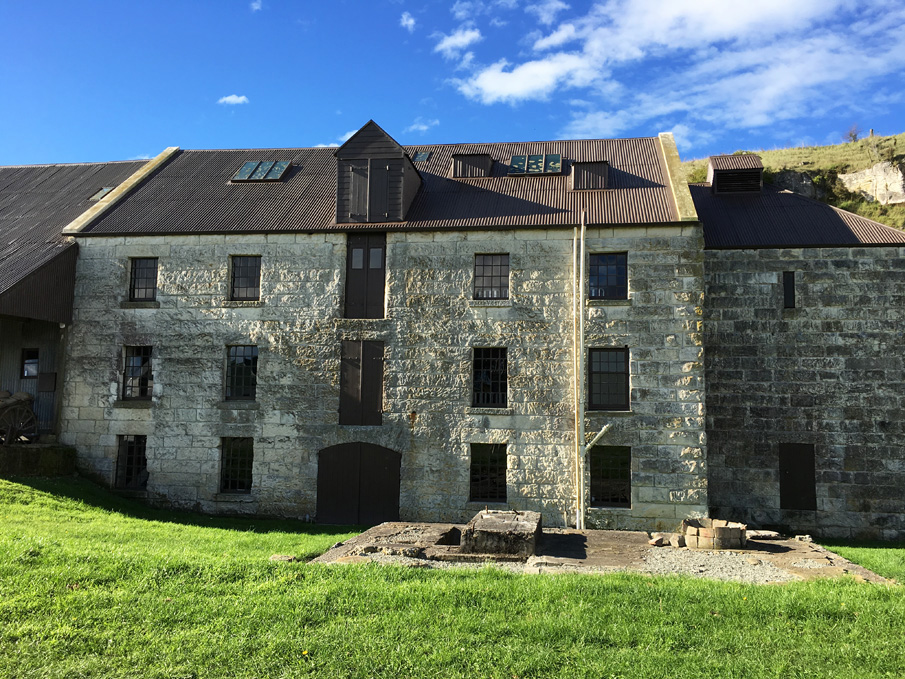
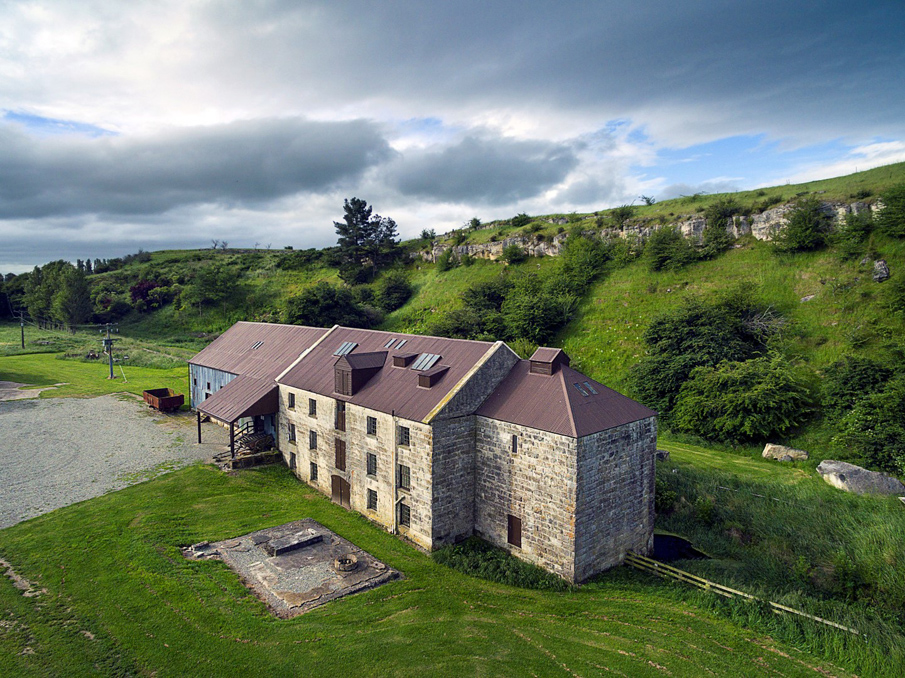
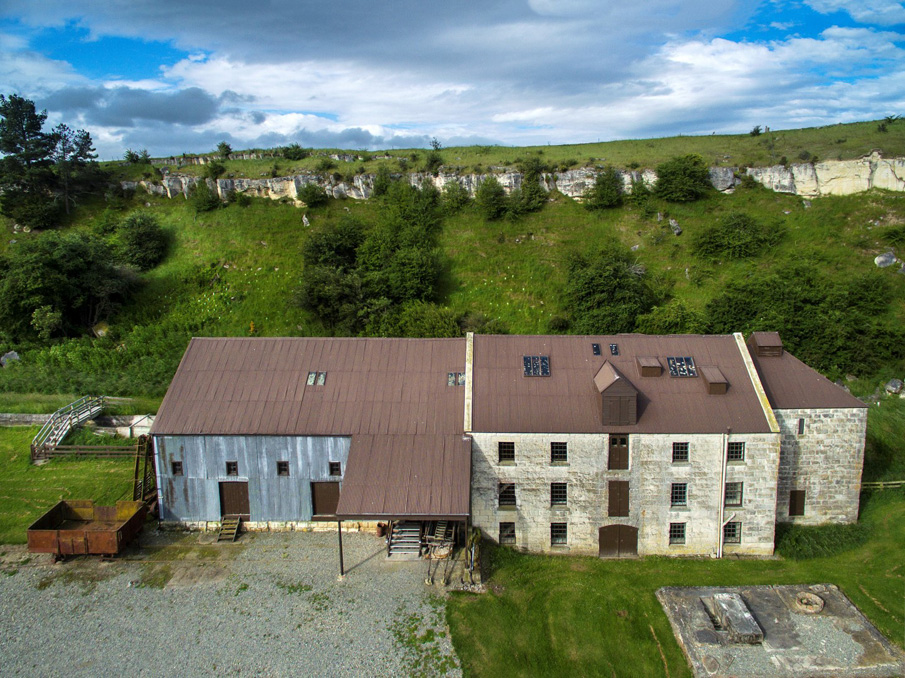
‘that the building will be three storeys in height, with lofting over all. It will have a very imposing appearance. The principal apartment will measure, inside the walls, 50 by 28 feet. The kiln-house [oatmeal house] measures 18 feet square. There will be four pairs of stones employed in the mill and the entire machinery will be driven by water led from the Kakanui River and conducted in a race six feet wide to the mill. The mason work will be of the most substantial description, the building stone being procured from an adjoining cliff, and the whole mill will be run up in courses of from 12 to 14 inches in height. The timber to be employed is to be the native red pine, totara, black pine, or miro; American, Baltic, or Kauri pine being used where specifically stated.’
By October Holmes and Campbell were looking for staff, advertising for ‘a thoroughly qualified Manager and Miller for the Kakanui Flour and Oatmeal Mills’, but sold the business shortly after. At the end of 1866 the New Zealand and Australian Land Company (NZALC) purchased the Totara Estate and the Mill from Holmes and Campbell for £98,326.5s.1d.
The Kakanui Mill was running by 14 February 1867, when a flour sample from the ‘recently erected’ Kakanui Mills was found to be ‘remarkably fine and pure’. Hector Brown, the first miller, was an experienced and community minded man who had come to New Zealand from Scotland in 1864.
New Zealand and Australia Land Company 1866-1901:
From the late 1860s large tracts of land in North Otago were bought by the New NZALC. The NZALC was formed by the Glasgow banker James Morton, in 1866, with a capital of £2,000,000 when it bought the Totara Estate and mill. Holmes stayed on in some sort of management capacity for a couple of years.
Flooding was a serious issue for the Mill. The most memorable flood was that of February 1868, in which nine people drowned at Totara Estate, and much damage was done at the Mill. A newspaper story described how, ‘the water rose four inches above the upper floor, being a distance of fully 20 feet above the ordinary level of the stream, which when the flood was at its height, was nearly a mile wide. It is feared that very extensive repairs will be required to the mill and mill-race.’ It was reported a week later that the mill wheel was completely destroyed, and the water had been ‘within six inches of the flour in the second [sic; first] floor of the building’. Flooding in May 1870 reportedly reached halfway up the ground floor window. In 1908 heavy rainfall caused four foot of water to enter the Mill. There were sizeable floods in 1932, 1938, 1940, 1961 and 1968. The heaviest was in June 1980, when the mill building was flooded above the ground floor.
The NZALC’s 1868 accounts show that they spent nearly £2300 on the Mill. The repairs required by the flood must make up a proportion of this expenditure, but the company also invested in coolers, conductors and elevators.
Anderson and Mowat: 1869-76:
Douglas, Alderson and Co took over the agency of the Mill, advertising it for let in June 1869. Anderson and Mowat took up the lease and in November advertised:
‘Kakanui Flour & Oatmeal Mills. To Merchants, Squatters, Bakers, Farmers and Others. We, the undersigned, Millers and Produce Merchants, Dunedin, have now got possession of these Mills, and will do gristing at lowest current rates. We are also in a position to supply flour and other produce at lowest prices. In connection with the Mill, we have opened a Grocery Store, where everything will be kept of the Best Quality, and sold at Dunedin prices. Anderson and Mouat, Dunedin Steam Flour Mills.’
The partnership of James Anderson (1830-1912) and Andrew Mowat (also spelt Mouat) had been formed in May 1865, and they ran a steam-powered flour mill in South Dunedin. They would later have other mills at Oamaru and Teaneraki.
Hector Brown continued as miller. In January 1873 he lived at Otepopo, so perhaps he had ceased working at Kakanui by then. He died in Dunedin in 1884. At the end of Brown’s time at Kakanui he trained Thomas Fleming (1848-1930) from Invercargill. Fleming took over management of the mill by 1873 and remained there until 1875, when he returned to Southland and managed, then bought, a succession of mills, closing them down to centralise flour production in Invercargill.
Anderson and Co: 1876-80:
In January 1875 the NZALC re-advertised the lease of the Mill, ‘now in the occupation of Messrs Anderson and Mowat’. The advertisement stated:
‘The Mill[..]is capable of turning out from fifty to sixty tons of flour per week, has a never-failing supply of water, and is within two hundred yards of the Southern Trunk Line of Railway to be opened shortly.’
Anderson and Mowat dissolved their partnership and by April 1876 the Mill was advertised by ‘Anderson and Co’. The first record of David Hay as manager Mill dates from May the next year. Hay’s father, William Hay, had been in New Zealand since 1860 and was an employee of Anderson and Mowat.
The development of the Mill was closely bound up with improved transport links. The railway reached Moeraki, running past Clark’s Mill, in November 1876, and Dunedin, by September 1878. A siding to connect the Mill with the trunk line was completed around 1877. This siding has been extremely important to this property and its occupiers, enabling them to efficiently transport the flour and to diversify their business.
Despite such developments NZALC were unhappy with the return on the Mill. In 1878 William Soltau Davidson, general manager of the NZALC, took an active interest in the company’s holdings. He noted that it was necessary to spend £400 repairing the foundations, and to buy a new wheel that could drive more pairs of stones, with the rent to increase accordingly, a potential point of dispute with tenants.
Daniel Forrest: 1880-84:
In early 1880 the NZALC listed the Mill for sale or let, stating that ‘The Mills are capable of turning out 50 to 60 tons of flour per week at present, with power for 100 tons, besides oatmeal.’
Daniel Forrest was a partner with Allan King in a Green Island mill until the partnership was dissolved. Forrest bought the Mosgiel Flour Mill in 1870. He marketed his flour under his own name, as ‘For(r)est’s Flour, Kakanui Mills’ from mid-1880 until mid-1885. Forrest frequently complained to the NZALC about the lack of water power and offered to pay interest on the cost of replacing the water wheel. Davidson noted that ‘I think on the whole it will be advisable for the company to sell the place when a good offer is obtained for it’. At the end of 1882 the NZALC called for tenders for a new turbine water wheel to make the Mill more productive. The turbine was installed the following year.
D. and J. Hay: 1884-97:
Former manager David Hay had left the Mill when Forrest arrived, advertising in March 1880 but also acted as agent for Forrest. Railway licence applications show that Forrest handed the Mill over to Hay around May 1884. David Hay advertised as a flour miller in Wises directory for ten years from1887.
Hay seems to have driven a fairly hard bargain with the NZALC, Davidson privately noting in 1886:
‘The Kakanui Mill has been a never ending trouble for the company as we have to go on introducing improvements to keep the tenant in the place as he naturally says that unless he can produce flour equal in quality to that ground at the new roller mills lately erected in the colony, he can not make his rent. We are getting about half the rent we got in 1878 and are glad to get a tenant at all seeing that the mill is rather old fashioned[..] The erection of the mill was a mistaken venture for the company and they would have been better without it.’
Davidson frequently reiterated this sentiment throughout the 1880s and 1890s, while considering other uses the Mill might be sold for, though other proposals came to nothing. Having sunk so much money in the mill, it was decided in mid-1892 to upgrade it by installing roller technology. The roller plant, with seven sets of elevators, was made by Otto Schumacher (Melbourne).
The Clarks: 1901-77
Clark Bros: 1901-1915:
Scottish born James Clark (d.1886) and his wife Anabella (née Lownie) arrived in New Zealand in 1878. In 1879, they took a lease on a farm near Maheno. After trying life as a sailor, and then a policeman, their son Alexander Clark (1863-1934) went into farming and contract threshing with two of his younger brothers in 1888, as Clark Bros.
Alexander Clark described how in 1901 he chatted with John Macpherson, manager at Totara and a regular client of Clark Bros. Macpherson asked ‘if I would care to buy a flour mill, as word had come from Glasgow to dispense with the mill at Maheno. I assured him that I knew nothing whatsoever about a flour mill but he persuaded me to pay a deposit, and having committed myself we left to look over the mill.’ The NZALC cut its losses, the £2200 paid by the Clarks well below its £5720 valuation two decades previously.
The transfer of the siding licence identifies the Clark Bros as Alexander Clark, David Clark, Robert B[l]aikie, and Al[l]an Stuart Clark. The railway siding enabled the Clarks to successfully diversify and they bought the quarry at Taipo, changing its name to A1 Stone Quarry.
A few months into their ownership the Clarks work on the mill, spending what Alexander later called ‘a small fortune’ on structural repairs and upgrading the machinery. The flour produced by Clark’s Mill was branded as ‘Snowdrift’, and their oatmeal as ‘Muscular’. The flour was later rebranded as ‘Snow wreath.’
Alexander Clark / Clarks Milling Co Ltd: 1915-77:
In 1915 Alexander Clark became the sole owner of the Mill, with the assistance of Robert McDowell, who was to become a shareholder. Alexander Clark had five children of whom Lex (the eldest), Colin and Allan (twins) followed him into the business. In 1929 they, alongside younger brother Lindsay became partners in Clark Milling Co Ltd. The brothers continued the business after Alexander’s death in 1934. Allan, was Managing Director, and managed production, whilst Colin was the company secretary and ran the business side. Lex worked in the business but retired due to ill health in 1966 and died in August 1975. Upon Allan’s death in April 1975, his son Warwick Clark became a director and alongside Colin managed the business until it was sold in 1977.
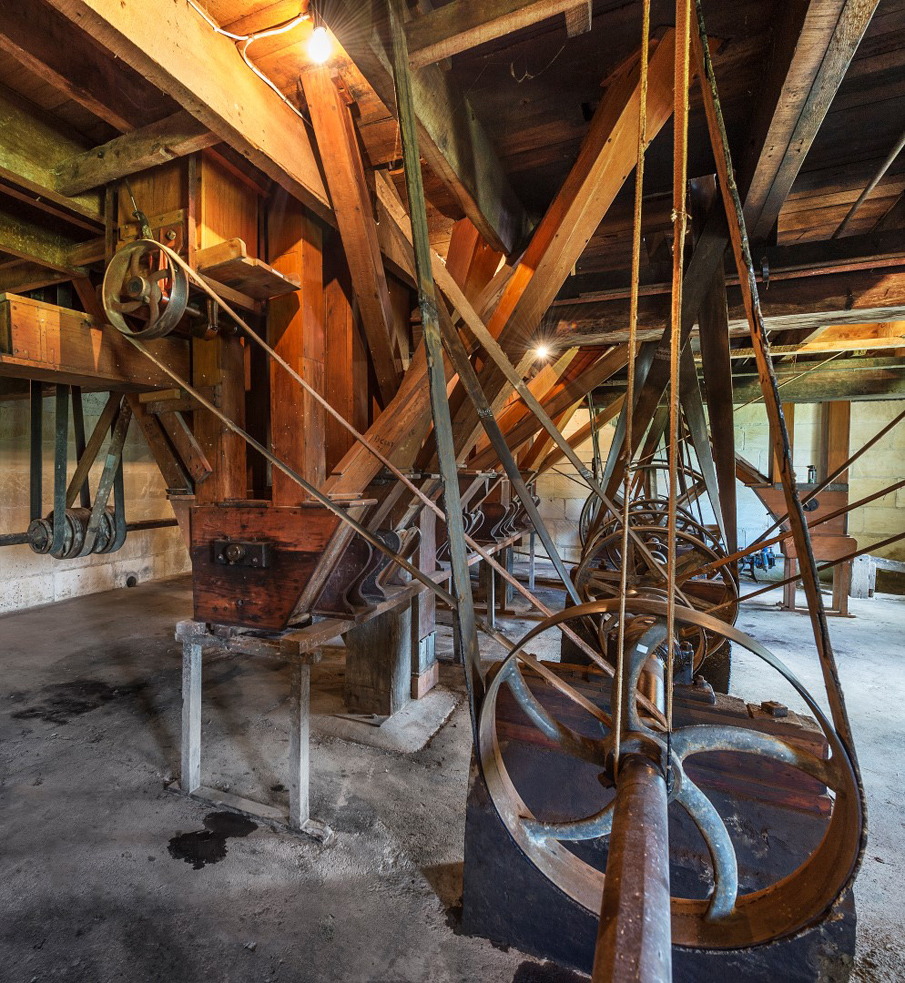
The Clarks continued to update the mill’s workings, in 1921 installing rollers and 1 plan sifter. In 1948 major works were carried out to the design of Henry Simon of Christchurch, requiring the mill to be shut down for almost a year. The improvements almost doubled the mill’s productivity. The power of the mill joined the national grid in 1945-46. New turbines were installed, driving the machinery and also generating electricity for lighting. These turbines were replaced by an electric motor in 1967.
During the Clarks’ ownership the Mill developed its status as a locus of social interaction and recreation. The Mill office now known as Smokey Joe’s gained its name and character after Allan Clark. Allan was sometimes referred to by his twin brother Colin as ‘Joe’ and he was also a heavy smoker. He may have returned from the war with this nickname. During service in the Middle-East he saw many night clubs and after returning to New he converted the company office into a ‘music hall’. The internal walls were removed and the walls and ceiling lined over with pinex. During the late 1940s a travelling sign writer stayed in Smokey Joes and painted Hawaiian scenes on the walls. The space was decorated with war memorabilia. Allan had a large music collection which he played in Smokey Joes. The space was sparsely furnished and had a record player and reel-to-reel tape recorder set up on a curved bar from which Allan entertained. Smokey Joe’s was used as a venue for parties and private functions. It was also used as the clubrooms for various sports organisations.
Northern Roller Milling Company: Jan.-Feb. 1977:
In late 1976 Clark’s Milling Company sought tenders for the sale of the Mill and sold to the Northern Roller Milling Company in January 1977 with its flour quota of 2394 tonnes. One factor in selling the Mill may have been that it would have required upgrading to meet health department regulations. The primary interest of the Northern Roller Milling Company was the flour quota, which was transferred to its northern operations, along with some machinery. They never ran the Mill.
New Zealand Historic Places Trust Pouhere Taonga: Feb. 1977- :
The NZHPT had first signalled their interest in the Mill in mid-1973. NZHPT wanted to work with the Clarks in the hope of preserving the Mill and its machinery for the future: if the Clarks in the future did want to sell the property the NZHPT would consider purchasing it.
After the Mill was sold to the Northern Roller Milling Company, NZHPT initially contacted its chairman to discuss the significance of Clark’s Mill and an NZHPT acquisition. After some negotiation the Northern Roller Mills agreed to sell the machinery with the buildings. In February 1977 the NZHPT purchased Clark’s Mill for $56,000.
The NZHPT intended to open the mill as a working exhibit, but not to produce flour commercially. The NZHPT offered Warwick Clark the role of caring for the mill machinery during the restoration project and ensuring it was kept in working order. At that stage it was estimated it would be five years before the mill could open to the public.
The works on the Mill were complicated and expensive, involving the demolition and rebuilding of large parts of the mill. Additional complication arose in 1978 when the dam was washed away, and in June 1980 with severe floods; resourcing problems further delayed progress. In March 1984 NZHPT received a development plan (never formally adopted) commissioned from Dr Jill Hamel. In addition to surveying the history and present status of the site, it proposed recommendations for developing and managing its future potential as a tourist attraction.
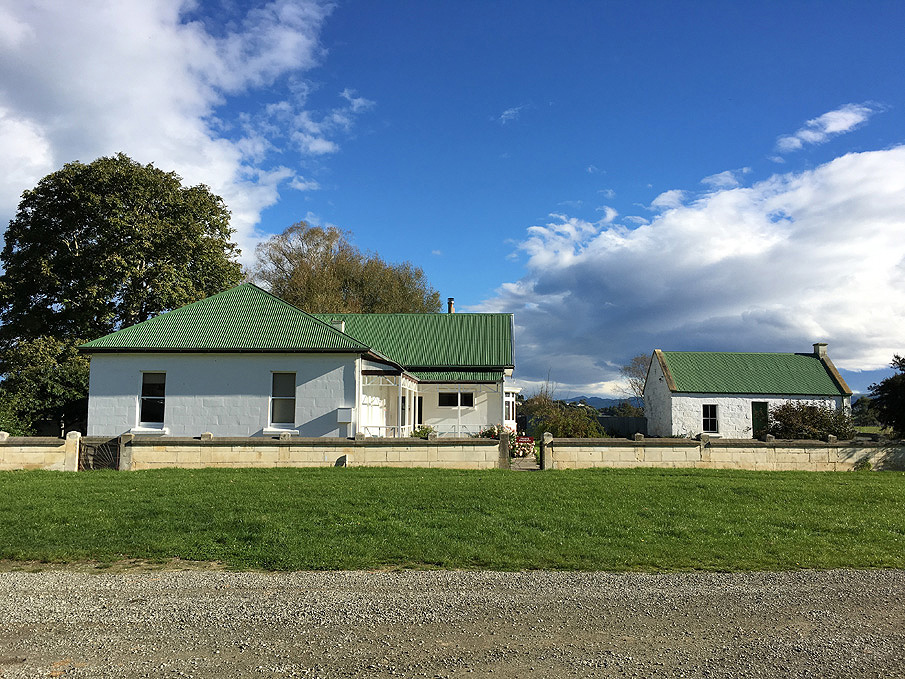
Milligan’s Milling Company of Ngapara approached NZHPT with a proposal to lease Clark’s Mill, to once again produce flour there and create a visitor attraction. The proposal fell through in 1989 and as a result NZHPT mothballed the mill, whilst leasing out the miller’s house and Smokey Joes to private tenants.
Like the Creamoata Mill Complex in Gore (Category I, Record No. 7470), the history of the Mill illustrates the changing fortunes of New Zealand's agricultural and primary processing industries. Flour milling was one of Otago and Southland’s most enduring industries and it played a major role in provincial development. Subsequent forces of economic rationalisation and globalisation have had a largely negative impact on these industries.
Clark’s Mill is an outstanding example of milling technology, being the only surviving water-powered flour mill with some machinery still intact. Clark’s Mill represents the rural flour mills that were built in the 1860s when wheat production was at its peak. Fleming was trained in his trade at Clark’s Mill, an important link with the establishment of Fleming’s Invercargill and Gore mills.
Other significant mills include Fleming’s Flour Mill in Invercargill, an important urban survivor of the flour milling industry, like Meek’s Flour Mill in Oamaru. Like Wakelin's Flourmill in Carterton (Category I, Record No.7634), and the Crown Milling Company Building in Dunedin (Category I, Record Number 366), Clark’s Mill Complex is a landmark in its community. Such mill buildings are special survivors as many were destroyed by fire, a fate to which the combustion of wheat made them prone.
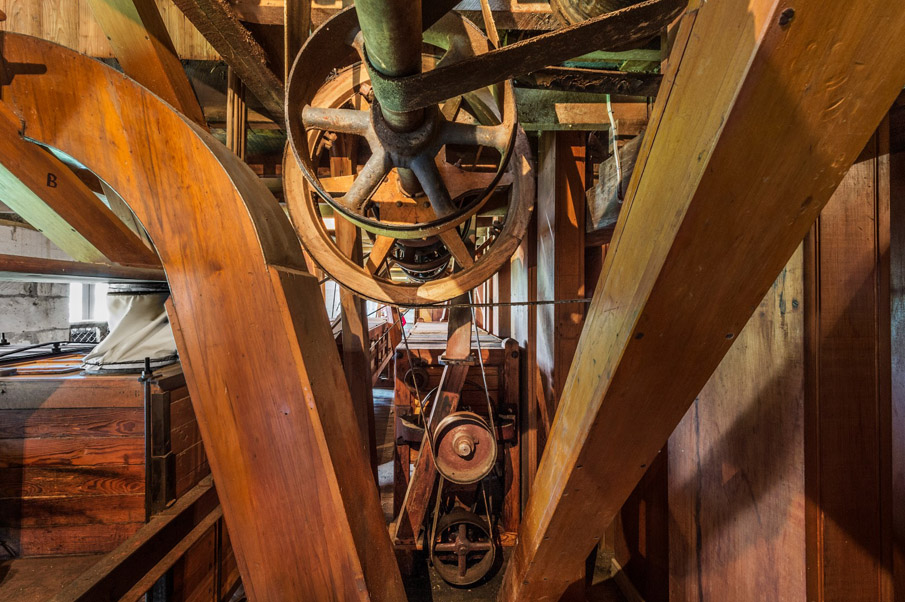
In 2011 Clark’s Mill is a significant tourist attraction. The Mill opens on Sunday afternoons, October to April. Of late a group of skilled volunteers has been restoring the mill machinery (see figure 20), and in the last year it has been demonstrated as a working exhibit on special operating days.